무엇을 찾고 계신가요?

If solar panel clamps are not compatible with module frames, the mounting connection may become loose, uneven, or mechanically unsafe. An incorrectly sized clamp can fail to grip the frame properly, while an unsuitable clamp design may create excessive pressure on the module edge. These problems can affect panel alignment, installation quality, and the long-term reliability of the photovoltaic system.
The most important compatibility factors are solar panel frame thickness, frame shape, clamp contact dimensions, mounting rail profile, and the installation torque specified by the component manufacturers. A clamp that fits one solar module does not necessarily fit another, even if both modules have similar external dimensions.
For solar installers and system integrators, checking clamp compatibility before purchasing mounting components is essential. SIC SOLAR provides different mid clamps and end clamps for framed photovoltaic modules, with product options designed for different frame dimensions and installation requirements.
Solar panel clamps connect the module frames to the mounting rails. Although they are relatively small components, they play an important role in transferring mechanical loads from the panels to the supporting structure.
A properly selected clamp should fit the module frame, engage correctly with the mounting rail, and apply pressure within the limits specified by the module manufacturer.
When the clamp and frame are incompatible, several problems may occur:
The solution is not simply to choose a stronger clamp. The clamp must be designed for the actual module geometry and mounting configuration.
Frame thickness is one of the first specifications installers should check when selecting solar panel mid clamps and end clamps. Common framed PV module thicknesses include 30 mm, 35 mm, and 40 mm, although other dimensions are also available.
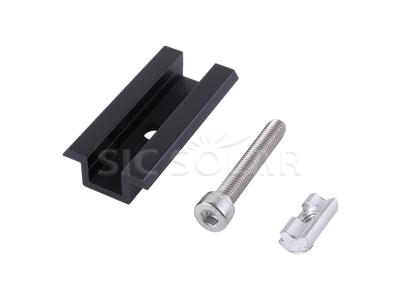
For example, SIC SOLAR's U Shape Middle Clamp For Framed Modules is designed for framed solar panels with thicknesses between 35 mm and 50 mm. It uses AL6005-T5 anodized aluminum and is available in silver and black.
The following table illustrates why frame dimensions should be checked before ordering mounting hardware. These are example matching dimensions, not a universal compatibility standard.
| PV Module Frame Thickness | Clamp Selection Consideration |
|---|---|
| 30 mm | Check whether the clamp is designed for a 30 mm frame. |
| 35 mm | Verify the clamp jaw height and contact area for a 35 mm frame. |
| 40 mm | Select a clamp with an approved 40 mm frame compatibility range. |
| Other dimensions | Confirm the actual module specifications and request a suitable clamp design. |
It is also important to distinguish between a clamp's advertised adjustment range and its approved installation range. Installers should always confirm the manufacturer's technical drawings and the photovoltaic module installation manual before making a final selection.
Mid clamps and end clamps perform different functions in a solar mounting system. Choosing the wrong type can affect how the module is secured to the rail.
Solar panel mid clamps: These components are installed between two adjacent framed modules. They hold the neighboring module frames against the mounting rail while maintaining the required spacing between panels.
Solar panel end clamps: These components secure the outer edges of the first and last modules in a row. They help prevent the modules from moving away from the supporting rails.
For example, SIC SOLAR's Solar Panel Mid Clamps are designed to connect adjacent framed modules to mounting rails. The Solar Panel End Clamps are used at the outer edges of a module row.
Both clamp types must be compatible with the module frame and the mounting rail. They should also be installed at the positions specified by the module manufacturer, rather than being placed wherever they are easiest to access.
Yes. An incompatible clamp can potentially damage the module frame or create mechanical stress if it does not engage correctly with the frame geometry.
For example, if the clamp jaw is too shallow, it may not provide sufficient engagement with the frame. If the contact surface is unsuitable, tightening the bolt may concentrate pressure on a small area instead of distributing it as intended.
The potential consequences include:
Installers should never force an incompatible clamp into position or use excessive bolt torque to compensate for a poor fit. The correct approach is to stop installation, verify the module and mounting specifications, and replace the component with a compatible design.
Yes. Frame thickness is important, but it is not the only compatibility factor. Two photovoltaic modules with the same nominal frame height may still have different frame profiles, edge geometries, or approved clamping zones.
Installers should pay attention to the following details:
For frameless or thin-film modules, conventional framed-module clamps should not be assumed to be suitable. SIC SOLAR also offers a Thin Film Solar Panel Mid Clamp designed for specific thin-film and frameless module applications. Its product configuration includes an EPDM rubber contact element, and the applicable module thickness and installation requirements should be checked before use.
Before ordering or installing clamps, project teams should compare the technical specifications of the photovoltaic modules with those of the mounting components.
A practical compatibility check should include the following steps:
For projects involving multiple module models, installers should not assume that one clamp configuration will work for every panel. A compatibility list based on actual module datasheets can help prevent ordering errors and unnecessary installation changes.
Some solar projects use modules with different frame thicknesses or require faster installation across large arrays. In these situations, an appropriately designed adjustable or quick-mount clamp can offer greater installation flexibility.
For example, SIC SOLAR's Solar Clamps Mid/End Clamp Quick Mount is designed for different framed-module thicknesses, with product information specifying an applicable range of 29 mm to 53 mm. The actual configuration and compatible rail profile should still be confirmed for each project.
Quick-mount designs can reduce some positioning and fastening steps, but faster installation does not replace compatibility checks. The clamp must still provide the required contact, engagement, and mechanical performance for the selected module.
For solar mounting system suppliers and EPC contractors, the most practical approach is to select clamps based on verified module specifications first, then consider installation efficiency and component customization.
A small component mismatch can become a costly issue when thousands of clamps are purchased for a commercial or utility-scale solar project. If the selected clamps are incompatible with the modules, the project may require replacement parts, additional labor, and installation schedule adjustments.
Before placing a bulk order, procurement teams should prepare a clear technical specification that includes:
SIC SOLAR supplies different solar mounting components, including aluminum mid clamps and end clamps for framed PV modules. Sharing module datasheets and mounting rail specifications with the supplier helps the technical team evaluate suitable clamp options before production and shipment.
SIC SOLAR provides solar mounting components for rooftop and ground-mounted photovoltaic projects. Its product range includes mid clamps, end clamps, quick-mount clamps, and specialized clamps for different module applications.
The selection process should begin with the actual PV module specifications instead of relying only on general descriptions such as universal solar clamps. Frame thickness, contact geometry, rail compatibility, installation torque, and project loading conditions all need to be considered.
For distributors, installers, and EPC contractors sourcing mounting components, SIC SOLAR can help evaluate clamp options according to the project requirements. Providing module datasheets, rail drawings, and estimated order quantities makes it easier to discuss the appropriate configuration.
Choosing compatible clamps from the beginning helps improve installation consistency, reduce component replacement risks, and support the mechanical reliability of the complete solar mounting system.
What happens if solar panel clamps are too large for the module frame?
An oversized clamp may not grip the frame correctly, potentially allowing module movement or creating an unreliable mechanical connection. The clamp should be replaced with a model that matches the frame dimensions and approved installation requirements.
Can I use the same solar panel clamps for 30 mm and 40 mm frames?
Only if the clamp is specifically designed and approved for both frame thicknesses. Some adjustable clamps support multiple frame heights, but the actual adjustment range and compatibility must be confirmed in the product specifications.
What is the difference between a solar mid clamp and an end clamp?
A mid clamp secures two adjacent solar panel frames along a mounting rail, while an end clamp secures the outer edge of a module at the end of a panel row.
Can conventional solar panel clamps be used for frameless modules?
Not necessarily. Frameless and thin-film modules may require specialized clamps with suitable contact materials and dimensions. Always follow the module manufacturer's approved mounting instructions.
How tight should solar panel clamps be?
Clamps should be tightened to the torque specified by the clamp and module manufacturers. The correct torque depends on the component design and should not be replaced with a general value applied to every installation.
What information is needed to select compatible solar panel clamps?
The key information includes the module model, frame thickness, frame profile, approved clamping zones, mounting rail specifications, and project loading requirements.



 한국의
 English
 Deutsch
 español
 português
 Nederlands
 العربية
 日本語
 Melayu
 Tiếng việt


 IPv6 네트워크 지원