회사
회사

What’s the Ideal Tilt Angle for Flat Roof Solar Systems to Maximize Energy Output?

What’s the Ideal Tilt Angle for Flat Roof Solar Systems to Maximize Energy Output?
Jul 16 , 2026

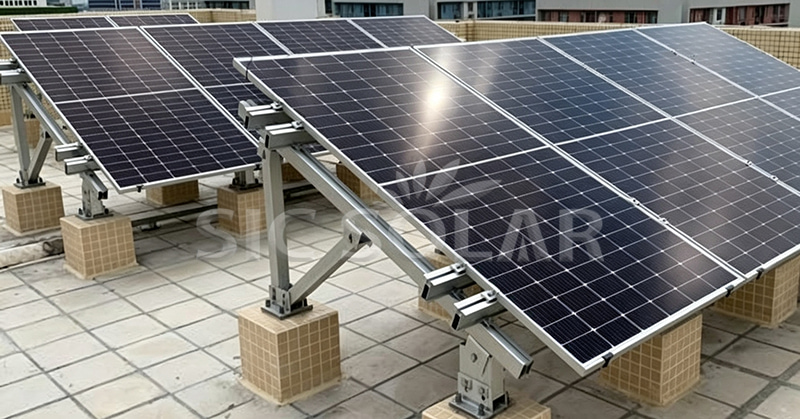
Flat roofs provide excellent flexibility for solar panel installations because the mounting system allows the panels to be positioned at the most suitable angle. Unlike pitched roofs, where the roof slope determines the panel orientation, flat roof solar systems can be customized to improve energy production while meeting structural and space requirements. Choosing the ideal tilt angle is one of the most important factors in maximizing the performance of a photovoltaic system.

flat roof mounting systems

In general, the optimal tilt angle depends on the project's geographic location. A common guideline is to set the panel tilt close to the site's latitude. This allows the solar modules to capture sunlight efficiently throughout the year. However, the exact angle may vary depending on seasonal energy demands, local weather conditions, and the desired balance between annual energy production and installation density.

For many commercial flat roof projects, tilt angles between 10° and 15° are widely used. This range provides a good balance between solar energy generation, wind resistance, and efficient use of rooftop space. Lower tilt angles reduce wind uplift and allow more panels to fit on the roof, making them especially suitable for large industrial and warehouse buildings.

Higher tilt angles, such as 20° to 30°, can improve energy production in some locations, particularly during the winter months when the sun is lower in the sky. However, steeper angles require greater spacing between panel rows to prevent shading. This reduces the total number of panels that can be installed on the roof, which may lower the overall system capacity despite the increased efficiency of individual modules.

Shading analysis is another essential part of system design. If panel rows are placed too close together, one row may cast shadows on the next, reducing power generation. Engineers calculate row spacing based on the selected tilt angle, roof dimensions, and local sun path to achieve the best overall performance.

Wind load should also be considered when determining the tilt angle. Steeper panels are exposed to greater wind pressure, requiring stronger mounting structures or additional ballast. In regions with frequent storms or high wind speeds, lower tilt angles are often preferred to improve structural stability and reduce installation costs.

The mounting system itself plays an important role in achieving the desired angle. Adjustable flat roof mounting structures allow installers to optimize panel positioning while accommodating different roof conditions. High-quality mounting systems also simplify installation and maintain long-term stability under changing weather conditions.

Manufacturers such as SIC Solar, a company specializing in the production and supply of photovoltaic mounting systems, offer flat roof mounting solutions designed for a variety of tilt angles and project requirements. Their systems support flexible layouts, reliable structural performance, and efficient installation for commercial and residential applications.

Besides maximizing energy production, the selected tilt angle should also support proper drainage and allow convenient access for cleaning and maintenance. A well-planned design ensures rainwater flows away efficiently while providing enough space for technicians to inspect and service the solar array.

Selecting the ideal tilt angle requires balancing energy yield, roof capacity, wind resistance, and installation costs. By combining accurate site analysis with a well-designed mounting system, flat roof solar installations can achieve reliable performance and long-term energy generation across a wide range of environmental conditions.

메시지를 남겨주세요
10년 이상의 태양광 경험과 전문성을 갖춘 SIC SOLAR는 경영이론을 고집합니다.
메시지 보내기

메시지를 남겨주세요

메시지를 남겨주세요
10년 이상의 태양광 경험과 전문성을 갖춘 SIC SOLAR는 경영이론을 고집합니다.
메시지 보내기

제품

whatsApp

연락하다